Ippolit Kirillovitch
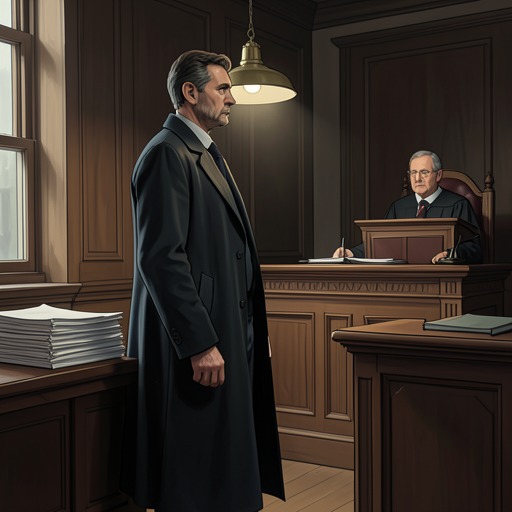
The Brothers KaramazovIppolit Kirillovitch is the prosecutor in Dmitri Karamazov’s trial, and his courtroom role is defined by a tension between forensic argument and passionate conviction. He approaches the case as a public advocate of justice, but the strain of speaking, his investment in the prosecution, and his dramatic denunciation of the alleged parricide make him more than a neutral voice for the evidence. His performance becomes one of the trial’s central spectacles: at once a professional culmination and a revealing portrait of the man who believes in his case.
Identity and Introduction
Ippolit Kirillovitch begins his speech in a state of visible physical distress. He is trembling, with cold sweat on his forehead, and feels hot and cold by turns. The account notes that he later described these symptoms himself, making his bodily reaction part of the record of how intensely he experienced the occasion. The speech is not presented as a routine prosecution address; it is an ordeal for its speaker as well as a set piece for the courtroom audience.
He regards the address as his chef-d’œuvre, the chef-d’œuvre of his whole life, and as his swan-song. That estimate gives the speech a double significance. For Ippolit, this is the work by which his professional life is to be judged; in retrospect, its finality is sharpened by his death from rapid consumption nine months later. His own comparison proves tragically apt, even though the speech’s importance within the trial also rests on its arguments and its effect on the people hearing it.
The Prosecutor’s Case
The trial’s discussion reaches a point where the known facts do not make it possible to determine which side is in the wrong. Ippolit then turns to the medical experts’ account of Dmitri’s fixed idea concerning the three thousand roubles he believed were owed to him. The evidence of the experts matters because it bears on whether Dmitri was out of his mind, as the medical witnesses contend, or in possession of his reason, as Ippolit argues. The prosecutor’s position is therefore not simply that the accused committed the crime: he also disputes the interpretation of Dmitri’s mental state.
In the following argument, Ippolit says the medical experts have tried to persuade the court that the prisoner is a maniac, and maintains instead that he is sane. This framing turns the expert testimony into a contested account of the accused rather than a settled diagnosis. It also connects the question of mental condition to the wider problem of how the evidence should be read: the same man whose conduct and fixation are examined by the experts is, in Ippolit’s presentation, answerable for his actions.
A later section of the prosecutor’s address takes up the source of suspicion surrounding Smerdyakov. The chapter’s title, “A Treatise on Smerdyakov,” marks a shift toward that question, and the speech considers how suspicion arose and what weight it should carry. The case is thus presented through competing explanations and inferences, not merely through a recital of established facts. Ippolit’s work as prosecutor involves constructing a coherent account from circumstances whose significance remains disputed.
A Reversal in the Courtroom
The prosecution’s account includes the door that Dmitri had forgotten and had not suspected Grigory could have seen. When the matter is raised, Dmitri leaps up and exclaims that Smerdyakov murdered his father. In doing so, he reveals the basis of a defense he had been keeping back, and reveals it in a form the account characterizes as improbable. The outburst changes the courtroom’s understanding of what Dmitri knows and of the argument he has been withholding.
This moment complicates Ippolit’s task. Dmitri’s sudden accusation appears to expose a concealed line of defense, but its unexpected form does not simply settle the question of guilt. The prosecution must contend with a new claim while continuing to press its own interpretation of the evidence. The scene makes courtroom argument depend not only on what can be proved, but on the changing credibility and meaning of what the participants say as the proceedings unfold.
The Final Peroration and Its Limits
Ippolit’s final peroration is delivered as if he were in a fever. He invokes the blood of the father crying for vengeance and presents the alleged murder as the work of a son acting from the base motive of robbery. The rhetoric gathers the case into a stark image of violated kinship and retribution. By the end of the speech, the prosecutor is no longer dealing only in the measured language of competing circumstances: he makes the accusation carry the emotional force of a demand for justice.
Yet the speech’s force also exposes its limits. The trial has placed uncertainty, expert disagreement, suspicion, and a sudden accusation in the same field of debate. Ippolit’s fervor can give his account urgency, but it cannot erase those tensions. The difference between a persuasive prosecution and a conclusive demonstration remains essential to the scene, especially because his final image presses the jury and audience toward moral judgment as well as factual assessment.
Public Performance and Narrative Role
The courtroom treats Ippolit’s arguments as a performance with consequences beyond the formal case. Later, when he rises to make objections, the people present look at him with hatred, and the ladies protest that he dares to object. Their response shows how quickly the audience’s sympathies can become attached to a speaker and how opposition to an appealing account may itself be received as an offense. Ippolit is not simply presenting evidence to a detached tribunal; he is speaking before a public whose reactions form part of the trial’s atmosphere.
The characterization of Ippolit therefore links personal ambition, physical strain, legal argument, and public feeling. He believes the speech to be the achievement of his life; the narrative confirms its closeness to a swan-song through his death nine months afterward. Within the trial, however, his most consequential role is to give the prosecution’s view of the case a coherent and impassioned voice, while the disputed evidence and the courtroom’s shifting responses prevent that voice from being identical with truth itself.